
Feeling Absence
Elegy for a Very Good Dog
I like to think that I would have said something ahead of time, if I had known I was going to take the summer off. Like, “Gentle Reader, summers are incredibly busy for me. I’m going to give myself the gift of zero expectations on Substack and every other writing project I think I should be working on, to reduce my level of stress.”
But I’m optimistic. Time optimistic. Energy optimistic. Focus optimistic. Part of me thinks I can do it all. Or that I should be able to do it all, and that it’s a copout not to try.
The thing is, I’ve learned that if I let my focus shift away from something, it can be hard to get that focus back.
There is value in getting distance from my projects. The absence of laser focus allows stuck ideas to dissolve, about how I’m supposed to approach the project, what it is supposed to be or accomplish, who I am in relation to whatever it is. My expectations can reset. My understanding has room to evolve.
The gyrations the world has been going through this summer have made trying to form a solid idea about it, trying to write as if I had something to say about it, feel like stepping into quicksand during an earthquake.
The only thing that has felt solid is the earth. My yard. My garden. Whatever piece of wood or foam or fiberglass I had in my hands. Friendships. Community.
So that’s where I’ve been hanging out.
Something shifted back this week. Through whatever grace of the Gods, the stars, or the first hints of coming fall, I find that I can focus on writing. Well, there is another possible explanation….
Anyway, I managed to return to a story I started two months ago, and finish it. I give you “Feeling Absence: Elegy for a Very Good Dog.”
A friend asked me in May, “What do you think you’ll do, when Sparks passes away? Get another dog?”
I’d brought the subject up. It was on my mind. Sparks hadn’t been doing well.
I said, “I realized the other day that I haven’t been without a dependent since 1985.”
My friend blinked. “That’s a long time.”
“Yes,” I said. “Forty years. I think I might need a break.”
What I meant was that for forty years I have lived with an unbroken series of beings for whom I have been responsible. For feeding and cleaning up after. For keeping them safe. For forty years I have, many times every day, sometimes continuously day and night, put someone else’s needs ahead of my own.
First there was Willikins, my golden retriever. Then Josephine, my cat. Her kittens, including Ernie, who I kept. Then my son, Dabo. His first cat, Blackie-White. His next cats, Mata and Sophia. My parents’ cats, Tiger and Tessa. Their dog, Mr. Chips. My Dad, who I took care of from a distance for three years, then up close for two. And then Sparks.
I’ve also had dozens of chickens. But they don’t count.
I got Sparks off Craigslist from a guy named Scott for $100 in the summer of 2015. Dad had lost his dog, a Shelty named Mr. Chips, two months earlier. He’d immediately started lobbying for a replacement. He wanted a dog, not a puppy, who was already trained to sit in his lap. He wanted to name the dog Sparkie, for the bright spark he imagined it would have in its eyes.
I tried to find a dog who fit that picture. Really. I searched Craigslist. We visited the pound. None of the dogs we saw came close.
Honestly, though, I didn’t want a lap dog, who barked and craved attention. Whatever dog we adopted, I knew that soon enough it would be mine. If I was going to have another dog, I wanted it to be a quiet dog. A dog who craved adventure. A dog who liked to run. A dog who would be a good friend to Phrin’s dog, Sophia.
When I saw Sparks’ picture on Craigslist, I thought, “This is the dog for me.”
Sparks was a retired sled dog. Scott, a long-time sled-dog racer with twenty-two dogs, had bred his Siberian Husky with his buddy’s German Short-haired Pointer, looking for speed. He considered the cross a failed experiment. Sparks, who he had named ‘Pink,’ after the color of the faded old collar he used on her, was the last of the litter to go. “After 25 miles,” he said, “Pink just doesn’t want to pull anymore.”
The first thing I noticed about Sparks in person was that she was afraid. “She’s a middle-of-the-pack dog,” Scott said. “Not dominant, or submissive. She’s the kind of dog who tries to stay out of the way.”
I saw a dog who would try to hide. Who didn’t feel comfortable around dogs or humans. She was three years old. She knew the world as dangerous. For a moment I considered not taking her. But there I was, and there she was, and the overwhelming sensation I felt was that she needed me.
Sparks was not the dog Dad wanted. During her first week here I wondered if she was the dog I wanted, either. She was terrified of my car. Terrified of the house. I got her inside the first day by having her on leash. When I accidentally let her out the front door without a leash, she refused to come back inside. She slept that night in front of the wood shed. When I pushed the subject in the morning, she ran away.
Did I tell you how fast she was? Did I tell you that taking off down the road at 15 miles per hour was, to her, as easy as breathing?
It took three hours to find her that day, and the help of five firemen, who happened to be on the road she’d decided to run up, to get her back in the car.
But we learned each other, Sparks and I. I learned patience in the face of her trauma. She learned to be motivated by food. I learned that I was responsible for showing her the rules. All of them. Like don’t go to the bathroom inside the house. Like don’t kill the chickens.
It is said that once a dog kills a chicken, you will never be able to stop that dog from killing again. This is not true. The day that Sparks killed her second chicken, and I found her in the back yard eating it, and I grabbed her and threw her to the ground and yelled at her and hit her … that day was a turning point for us. I thought she would hate me for hitting her. Instead, she suddenly trusted me. She willingly followed me back inside. I had finally shown her I was the one in charge. She could relax. At least a little.
After that day Sparks always skirted wide of the chickens, glancing sideways at them with wary eyes, lest they somehow manage to end up in her mouth.
Sparks was never was Dad’s dog. That fall, after I got her, Dad’s dementia progressed to where I could only leave him alone for short stretches of time. I started walking Sparks by driving behind her in a car on the old logging roads. She loved it. Mostly she trotted along at 5-9 miles per hour. Sometimes she’d sprint at up to 19.
Soon enough she went from being a failed, traumatized sled dog, to a happy, content house dog. Because of her I hiked thousands of miles in beautiful places across the country. I had ten amazing years with her. My only regret was that I hadn’t known her as a puppy.
I told her, last summer, that if she ever wanted to come back, I would find her when she was still a puppy and take her home. I wanted her to know from the get-go how wonderful she was. I wanted her to have the experience of never doubting she was loved.
The next day she developed a weird cough.
I said, “I didn’t mean right now!”
The cough turned into wheezing. When she exerted herself too much, or it was too hot outside, she could barely breathe. The veterinarian said there was nothing to do, other than keep her cool.
We took our walks early in the morning that summer. By the middle of winter, any exertion brought the wheezing on. In one year Sparks went from 3 miles being a friendly stroll to ½ a mile being a challenge. I repeated my promise, to find her as a puppy, but also to stay with her as long as she wanted to stay with me.
It ended kind of like with Dad. The lead-up was slow, and grueling, but the end was swift. A surprise, but not a shock. On June 3rd, somewhere in the afternoon, Sparks lay down and couldn’t get up. I hung out with her as much as I could that day. I would have taken her to the vet, but she was deep inside of what she was going through. It felt like I shouldn’t interfere.
At 1 am I woke to the sound of Sparks straining to breathe. It took all of the strength left in her body to suck in thin whistles of air. It looked and sounded horrible. Had I made a terrible mistake? Was there a vet I could take her to this late at night? How long would it take to get there? Why had I waited?
Freaking out wouldn’t help her, I realized, so I slowed down, to listen for an answer to what to do.
I heard, “This is perfect. This is what it takes. Nothing is wrong.”
I slowed down for several more minutes before I felt, “Nothing is wrong.” But I got there. In that moment, her breathing stopped.
What is it to feel absence? To touch the edges of a reality that has changed? To see yourself without that thing, person, being, experience, you’ve become accustomed to?
In the last year all three of my animals had died. I was now living alone for the first time in forty years.
I still had chickens, but they don’t count.
By which I mean, for forty years I have been the daily beneficiary of hugs, words and looks of unconditional love, given and received.
I started talking to the chickens more.
It turns out I can get a lot of work done, when no one is pulling me away. I cleared more ivy from my forest and took down several small dead trees. I led a workshop about building stairs in the woods. I finished cleaning my shop. I built a boat. Ever since January I’d been working close to full time on my house and yard. Without anyone to take care of I slipped into overdrive. 10-12 hour days accomplishing. Accomplishing. Accomplishing. Exhausting myself. There was no reason to stop.
“You need to rest, Kim,” Phrin said.
But it was summer. The days are so long so you can work that long, right? It was thrilling to get so much done.
“You need balance, my friend,” Robyn said.
What does balance even mean, when you’ve come unmoored?
Every morning when I came downstairs I had to remind myself Sparks wasn’t waiting for a cuddle. She didn’t need to go outside or to be fed. She wasn’t there, though it felt like she was.
I began to develop a habit of looking for puppies online.
“Take your time,” Phrin said. “Maybe she isn’t ready to come back, yet.”
Right. It would be two months, anyway, before a new puppy was ready to come home.
“Well,” Phrin said, “time isn’t linear, that way, for reincarnation. Some souls inhabit more than one body at once.”
Which made me stumble inside, a bit. I wasn’t ready. I needed a break. I was enjoying the emptiness.
But I kept looking, just to see.
My Craigslist search was narrowed to 15 miles, because going any farther than that seemed like too much. There were cute puppies, but I never saw one who made me want to hop in my car.
And then came last Thursday. It had been 10 weeks since Sparks died. She was strong in my thoughts that day, like she was calling to me. What the heck, I thought. I widened the search all the way, 200 miles.
Not very many ads down I saw a puppy’s picture, and thought, “That’s my dog.”
Was it because he is, also, a German Pointer-Siberian Husky mix? Was it because this is exactly what Sparks would have looked like as a puppy? Does it matter?
On Saturday Phrin, Miu (her cat) and I drove 200 miles to Richland to bring him home.
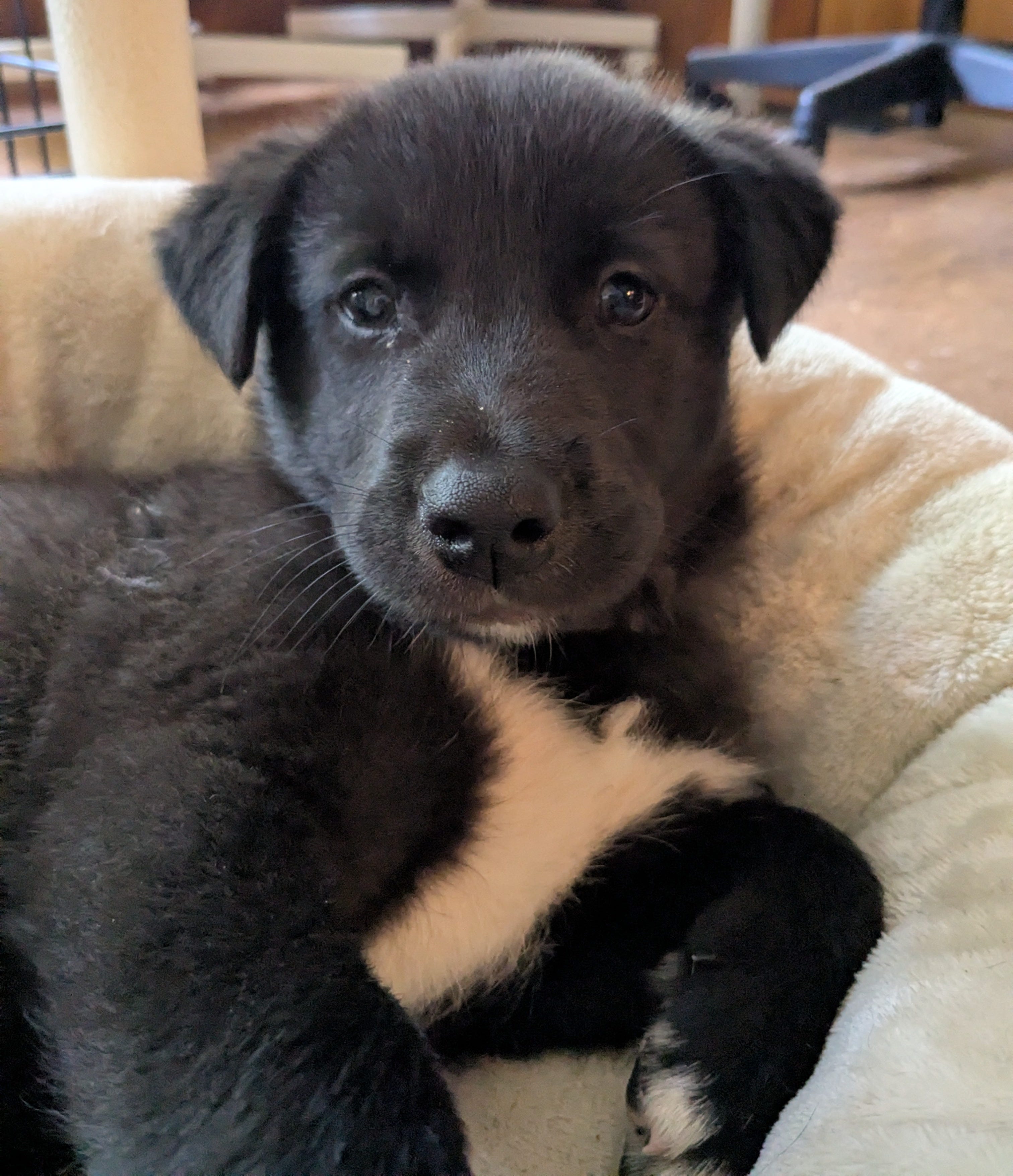
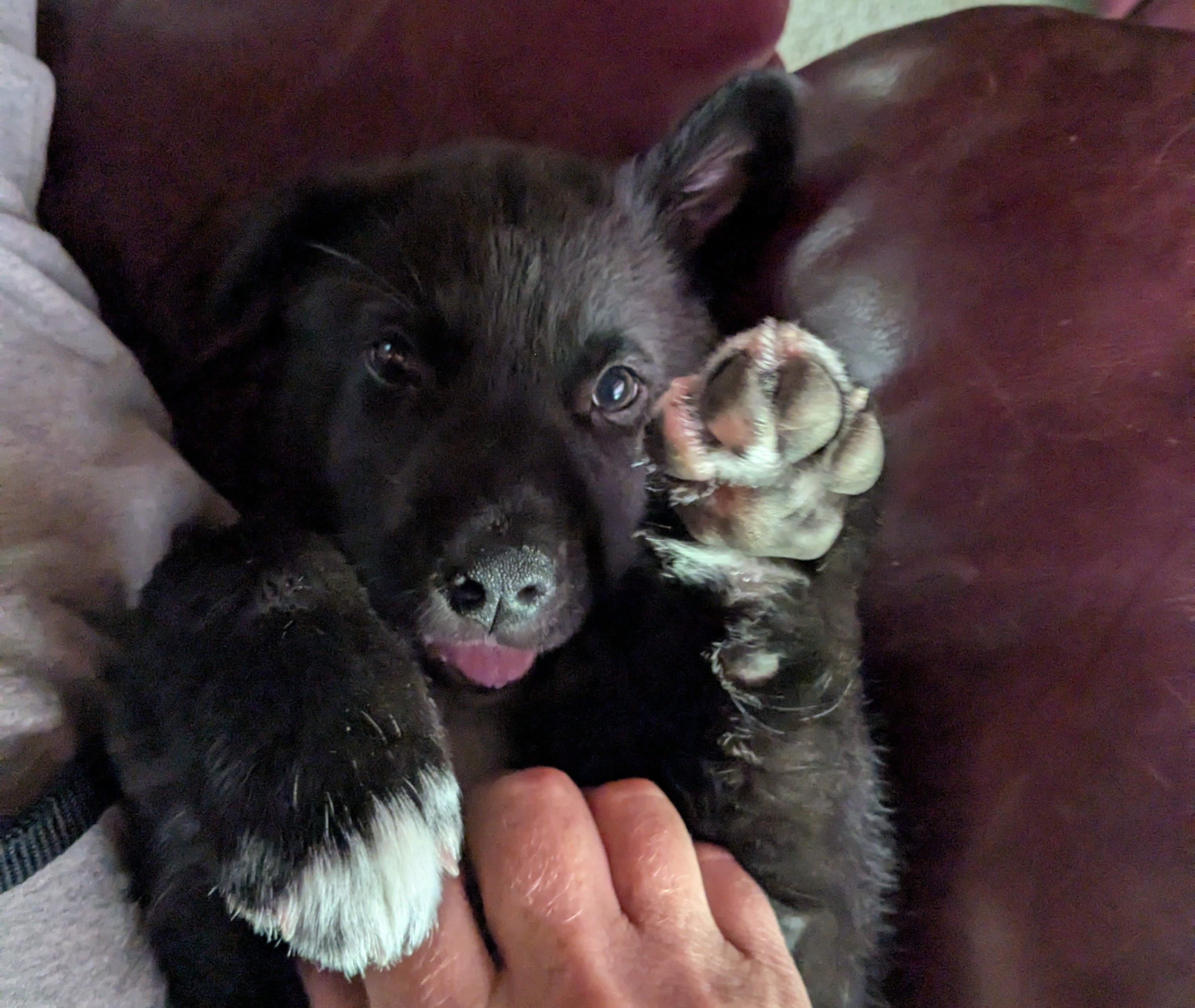
May you and Buck have many wondrous adventures together!
What a beautiful tribute to life with Sparks and introduction to Buck. I am so happy for you.